The right number of custom shelf talkers equals the shelf positions that need a sign, times the number of stores, plus a small allowance for replacements and late additions. Custom Shelf Talkers prints runs from a minimum of 12 with a free mockup within 24 hours, so you can test one aisle first and scale once the count is proven.
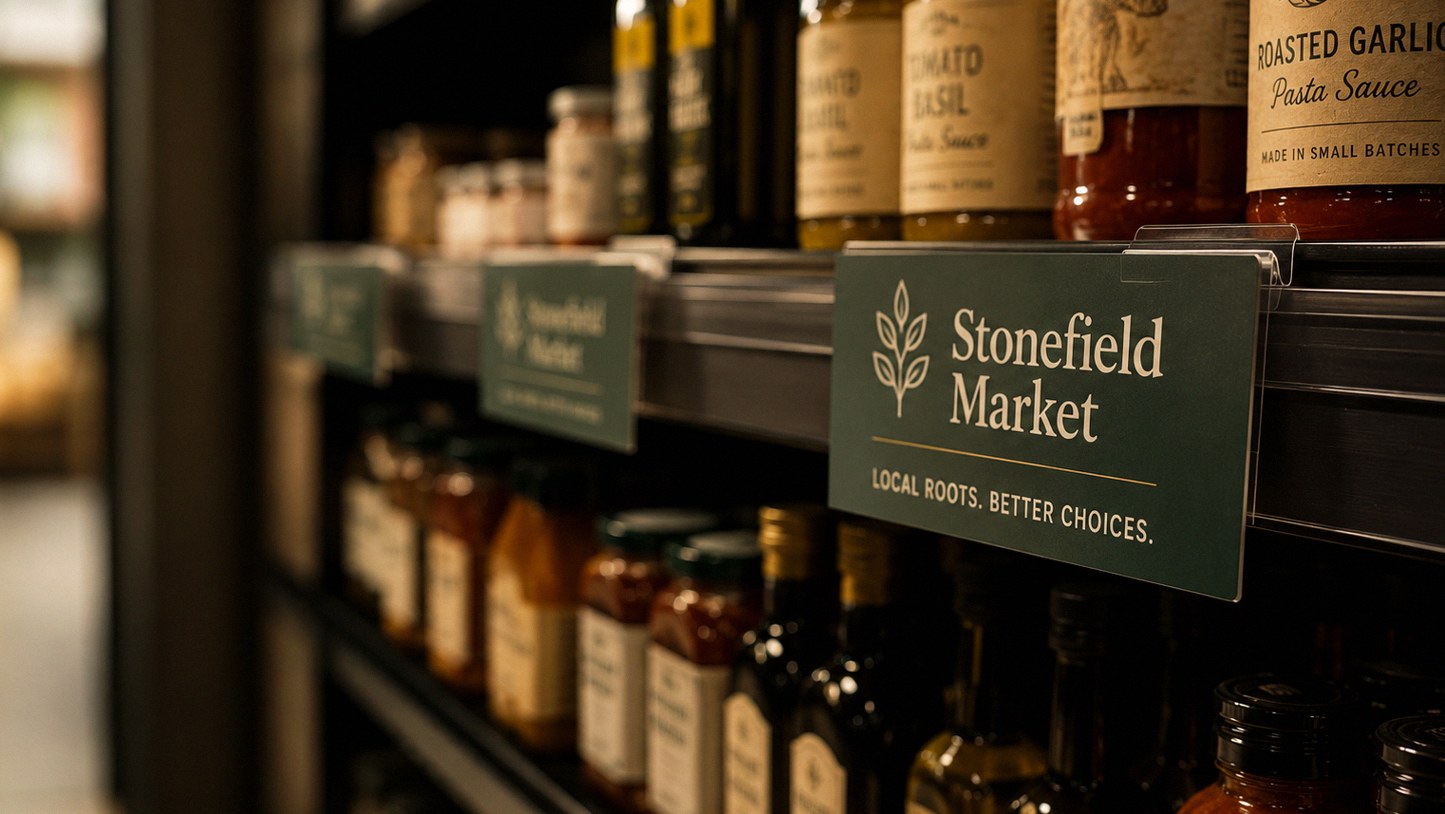
- Count real shelf placements, not a round number
- Minimum order of 12 shelf talkers
- Free mockup within 24 hours of your request
- Standard turnaround about 2 weeks after approval
- Pay nothing until you approve the design
How many custom shelf talkers should you order?
The right number of custom shelf talkers is the count of shelf positions that need a sign, multiplied by the number of stores, plus a sensible allowance for signs that get lost, damaged or added late. Most quantity mistakes come from guessing a round number instead of counting real placements, which leaves some shelves bare and others with a box of unused signs in the back room.
Start with the job each shelf talker does. A staff pick sign might live on one facing per store, while a dietary callout could repeat on every qualifying product in an aisle. Write down each message, then count where it will hang. That simple list turns a vague order into a plan you can defend to a store manager or a brand partner.
- Messages: list each distinct design you need, such as new item, staff pick, local maker or featured promotion.
- Placements: count the shelf positions, coolers, endcaps and case stacks for each message.
- Locations: multiply by the number of stores or departments that will run the program.
- Allowance: add extras for replacements, resets and shelves you missed on the first walk.
Custom Shelf Talkers starts every order at a minimum of 12, so even a single-store test can use a real printed run rather than handwritten cards.
How do you count the shelf positions that need a shelf talker?
Counting shelf talker positions works best when someone physically walks the aisles with a clipboard or phone and marks every spot the sign will hang, rather than estimating from a planogram. Planograms show where products should sit, but they rarely show the cooler door, the wire rack lip or the case stack at the end of the aisle where a sign would actually earn attention.
Walk the store in the order a shopper does. Note each product facing that gets a sign, then look for the extra spots that are easy to forget: endcaps, freezer and dairy doors, checkout lanes, seasonal tables and floor displays. Each of those spots may suit a different style, so record the mounting type next to the count.
- Shelf edges with a price channel suit a standard rectangle shelf talker.
- Wire racks, cooler shelves and thin edges often need a clip-on shelf talker.
- Stacked cases and pallet displays call for a case-stack header talker.
If your stores share a layout, count one store carefully and use it as the template. If layouts differ, ask a manager at each location to run the same walk and send back their numbers. A quick count from the people who stock the shelves beats any desk estimate, and it gives you a quantity you can send straight to the quote form.

How much extra should you add for replacements and late additions?
A shelf talker order should include a modest allowance on top of the counted placements, because signs get knocked off by carts, peeled away during restocking, damaged by cooler condensation or claimed by a product that was added after the count. How much extra depends on how rough the environment is and how long the signs need to last.
Think about wear in each department. A shelf talker in a quiet wine aisle may survive the whole program, while one on a busy cooler door or a high-traffic endcap faces daily bumps. Short promotions need little cushion because the sign comes down soon. Evergreen signs that stay up for months need more, since replacements will happen over time.
- Add more extras for coolers, freezers, endcaps, checkout lanes and stores with frequent resets.
- Add fewer extras for short promotions, quiet aisles and signs mounted in protected price channels.
- Keep extras together in a labeled envelope at each store so staff can replace a sign without waiting.
Material matters too. Sturdier stock and plastic options hold up better where moisture and handling are constant, which can reduce how many replacements you need. If you are unsure which material suits a location, Custom Shelf Talkers can suggest one when you request your free mockup.
Is it better to order one large run or several smaller shelf talker orders?
One larger shelf talker run suits messages that will not change, while several smaller staged orders suit programs where wording, products or store counts are likely to shift. The deciding question is how confident you are that the design you approve today will still be right in a few months.
A single run keeps every sign identical and means one approval and one delivery. The downside is that a price change, a discontinued product or a rebrand can strand a stack of signs that no longer apply. Staged orders let you print what you need now and adjust the next batch based on what worked on the shelf.
| Approach | Best for | Watch out for |
|---|---|---|
| One large run | Evergreen messages, store-brand callouts, permanent dietary or local maker signs | Signs becoming outdated if products or branding change |
| Staged smaller orders | Pilots, seasonal programs, new item introductions, rollouts still adding stores | Leaving enough lead time for each reorder |
| Test then scale | First-time programs where you want proof the sign works | Keeping the approved artwork on file for the larger run |
Because the minimum is 12, a test order in one store or one aisle is practical. Run it, see whether shoppers and staff respond, then order the full quantity with confidence.
How do evergreen and promotional shelf talkers change the quantity?
Evergreen shelf talkers, such as staff picks, local product callouts or gluten-free markers, are counted once and replaced over time, while promotional shelf talkers are counted per promotion and retired when it ends. Mixing the two in one plan without separating them is a common reason orders come out too big or too small.
For evergreen signs, count the placements and add a replacement allowance that covers the months ahead. Leave off anything that names a date or a temporary offer, so the signs stay useful as long as the products stay on the shelf. A blank write-on area can extend their life further by letting staff update a note by hand.
For promotional signs, count only the products and stores in that promotion. A fluorescent sale shelf talker is built to grab attention for a limited window, so order close to the real count and plan the next promotion as its own order. If you run promotions on a regular cycle, consider a generic sale design without dates that can be reused every time.
- Separate evergreen and promotional counts on your planning sheet.
- Keep dates and temporary offers off evergreen artwork.
- Reuse a generic sale design when promotions repeat.
Do shelf talker styles affect how many you need?
Shelf talker style changes the count because each style fits a different kind of placement. A shelf-edge sign repeats along many facings, while a header or die-cut piece usually appears once per display. Planning by style keeps you from ordering a large run of a shape that only suits a handful of spots.
| Style | Typical placement | Quantity pattern |
|---|---|---|
| Standard rectangle | Price channels on gondola shelving | Repeats across many facings and aisles |
| Clip-on | Wire racks, coolers, thin shelf edges | Repeats where clips are the only mounting option |
| Case-stack header | Stacked cases, pallets, floor displays | Usually one per display per store |
| Die-cut shape | Hero products and flagship displays | Fewer pieces, placed where attention matters most |
| Fluorescent sale | Short promotions and markdowns | Matched closely to the products on promotion |
Count each style on its own line. Custom Shelf Talkers can quote a mix of styles together, so your planning sheet can go straight into one quote request.
When should you reorder custom shelf talkers?
The time to reorder custom shelf talkers is when your remaining extras will not cover the replacements expected over the next production cycle. Standard turnaround at Custom Shelf Talkers is about 2 weeks after you approve the design, with faster turnaround available through express shipping, so a reorder should go in well before the last spare is used.
Ask each store to tell you when their envelope of spares runs low, rather than when it is empty. Keep the approved artwork and the original quantity on file so the reorder is a quick confirmation instead of a new project. If you want changes, such as a new headline or an added product, the next mockup still arrives within 24 hours and revisions remain free.
- Set a low-spares trigger for each store or department.
- Review which placements wore out fastest and adjust material or style.
- Update the count for stores or products added since the last order.
- Request the reorder at least 2 weeks before you expect to run out.
Launch programs need their own timing. If a new item is coming, see the guide to custom shelf talkers for product launches and order before the item reaches the shelf.
What should a first-time buyer check before confirming a shelf talker quantity?
Before confirming a shelf talker quantity, a first-time buyer should check that every message has a counted placement, every placement has a matching style, and the allowance reflects how hard each location is on signs. A few minutes on this checklist prevents both bare shelves and wasted print.
- Did someone walk the store and count real placements, including coolers and endcaps?
- Is each message assigned to a style that fits its mounting spot?
- Are evergreen and promotional signs counted separately?
- Is there an allowance for replacements, sized to the department?
- Are dates and temporary offers kept off signs meant to last?
- Does the order meet the minimum of 12?
- Is there enough lead time for about 2 weeks of production?
Once the list checks out, send your counts through the custom quote form. Custom Shelf Talkers returns a free mockup within 24 hours, offers unlimited free revisions and asks for nothing until you approve the design. You can read the full process on the how it works page.
Frequently asked questions
How do you count shelf facings when planning a shelf talker order?
Counting shelf facings for a shelf talker order means walking each aisle and marking every product position that will carry a sign, then adding coolers, endcaps and displays the planogram misses. Record the mounting type beside each count so the right style is ordered. Custom Shelf Talkers can quote mixed styles together, so one walk-through sheet can become one quote request.
Why do shelf talker counts often come up short after installation?
Shelf talker counts usually come up short because the original estimate came from a desk instead of the sales floor. Cooler doors, wire racks, checkout lanes and late product additions get missed, and carts knock signs loose during the first week. A physical store walk plus a small replacement allowance closes most of that gap before the order is placed.
Is it better to order one large run of shelf talkers or several smaller ones?
A single large run of shelf talkers suits evergreen messages that will not change, while staged smaller orders suit pilots, seasonal programs and rollouts still adding stores. The risk with one big run is signs going out of date. Custom Shelf Talkers keeps approved artwork on file, which makes a later staged order quick to confirm.
Can a small shop order exactly 12 shelf talkers for a short test?
Yes, shelf talkers from Custom Shelf Talkers start at a minimum of 12, so a small shop can print a real run for a single aisle or display. A short test shows whether shoppers notice the sign and whether staff find it easy to maintain. If the test works, the same approved design can be reordered in a larger quantity.
How do evergreen and promotional shelf talkers change the quantity you order?
Evergreen shelf talkers are counted once and need a replacement allowance for the months they stay up, while promotional shelf talkers are counted per promotion and retired afterward. Keeping the two counts separate prevents oversized promotional runs and undersized evergreen ones. Leaving dates off evergreen artwork also keeps those signs useful far longer on the shelf.
How do shelf talker quantities differ between clip-on and case-stack header styles?
Clip-on shelf talkers tend to repeat across many wire rack and cooler positions, so their counts grow with the number of facings. Case-stack header talkers usually appear once per stacked display in each store, so their counts follow the number of displays instead. Planning each style on its own line keeps the overall order accurate and avoids surplus.
Should store staff help estimate how many shelf talkers to order?
Store staff are often the best source for a shelf talker estimate because they stock the shelves and know where signs get damaged or removed. Ask a manager at each location to count placements and note rough spots like cooler doors. Their numbers, sent through the Custom Shelf Talkers quote form, usually beat any estimate made from head office.
How do you plan shelf talker quantities for a multi-location retail rollout?
Planning shelf talker quantities for a multi-location rollout starts with one carefully counted template store, then adjusts for locations with larger or different layouts. Group stores by format, count each group, and add a replacement allowance per store. Custom Shelf Talkers can quote the combined total so every location receives matching signs from the same approved design.
Can ordering too many shelf talkers become a problem?
Ordering too many shelf talkers becomes a problem when the extras outlive the message, such as a discontinued product, an expired offer or a brand refresh. Surplus signs then sit unused in back rooms. Counting real placements, keeping dates off long-term artwork and staging reorders through Custom Shelf Talkers keeps the quantity close to what the shelves actually need.
How does the 2 week turnaround affect when to reorder shelf talkers?
Shelf talker reorders should be timed around the standard turnaround of about 2 weeks after design approval, with faster turnaround available through express shipping. Set a low-spares trigger at each store so the reorder goes in before signs run out. Custom Shelf Talkers keeps your approved artwork on file, which keeps the reorder step short.
What happens to shelf talker quantities when a store resets its shelves?
Shelf talker quantities often change during a shelf reset because products move, facings are added or removed and some signs get thrown out with old fixtures. Recount placements after the reset rather than before, and plan a small reorder to cover new positions. Custom Shelf Talkers can update artwork for moved or new products within 24 hours.
Does the material of a shelf talker change how many spares you need?
Shelf talker material affects spares because sturdier stock and plastic options survive moisture, handling and cart bumps better than lighter card. Signs in coolers and high-traffic endcaps wear out faster, so either upgrade the material there or add more extras. Custom Shelf Talkers can recommend a material for each placement when preparing your free mockup.
Get a free mockup for your shelf talkers
Send your logo or idea and the quantity you have in mind. Custom Shelf Talkers returns a free mockup within 24 hours, you approve the design before anything is produced, and standard turnaround is about two weeks with faster options available. Get a custom quote.