Author: George

  • How to Choose Custom Shelf Talkers for Your Brand

    How to Choose Custom Shelf Talkers for Your Brand

    How to Choose Custom Shelf Talkers for Your Brand: Use Cases and Ordering

    The best way to choose custom shelf talkers is to start from how they will be used, then work back to the material, size, and decoration that fit. Custom shelf talkers serve very different jobs across retail & pos, events & activations, outdoor & venues, and storefronts, and matching the order to the job is what makes custom shelf talkers feel purpose-built rather than generic. This guide maps the common use cases and walks through ordering custom shelf talkers that fit your brand.

    Whether the shelf talkers protects a product, presents a gift, or carries a logo into the world, defining that job first keeps every later decision easy. Purpose drives the spec, and the spec drives the result.

    How businesses use custom shelf talkers

    Custom shelf talkers get ordered for a mix of protection, presentation, and promotion, and knowing where yours fall points you to the right build. The breakdown below shows the common uses, from retail & pos to storefronts.
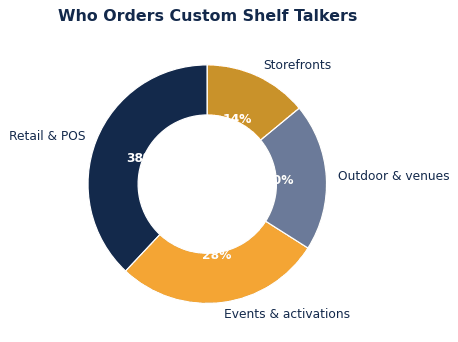
    The common ways businesses put custom shelf talkers to work.
    The common ways businesses put custom shelf talkers to work.

    Most orders lean toward one primary job with a secondary benefit — a shipping-focused shelf talkers that also brands the unboxing, or a gift-focused one that also protects. Naming your primary use keeps the order focused and the spec appropriate.

    Use case What it needs
    Retail & POS displays that guide attention and lift sales
    Events & activations branded backdrops and step-and-repeats
    Outdoor & venues weather-ready signage that stays visible
    Storefronts window and wall graphics that draw foot traffic

    Matching material and size to the use

    Once the use is clear, the material and size follow. A protection-first job favors a durable, well-fitted build; a presentation-first job favors a premium material and a clean print; a promotion-first job favors a cost-effective option you can order in volume. Sizing to the product with a small margin keeps the shelf talkers looking intentional and performing its job.

    If a single order serves more than one use, spec to the most demanding one so the shelf talkers performs everywhere. It is easier to use a slightly sturdier or more premium shelf talkers across the board than to discover a bargain option falls short for your most important use case.

    Branding for the impression you want

    Decoration should reinforce the impression the use calls for. Large-format digital printing reproduces full-color graphics sharply, with laminate options for durability and finish. For a premium or gift use, lean on finishes and restraint; for high-volume promotion, prioritize a bold, legible logo that reads at a glance and reproduces affordably at scale. Keep branding consistent with the rest of your packaging or merch so everything reads as one system.

    The most-requested options below reflect what buyers reach for most, and they are a useful starting menu when you brief your order. Whatever you choose, approve a proof so the finished custom shelf talkers match the impression you intended.
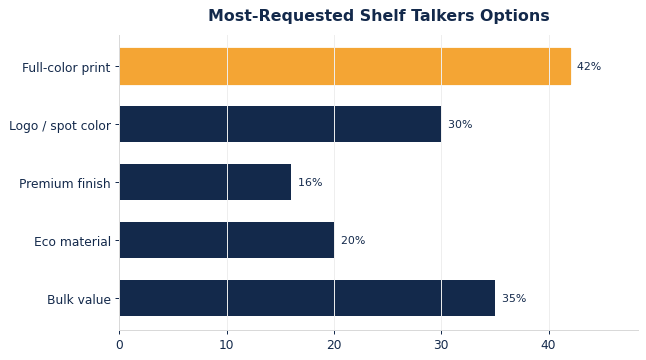
    The options buyers request most on custom shelf talkers.
    The options buyers request most on custom shelf talkers.

    Getting the size and details right

    Even with the use and material decided, the details are what make custom shelf talkers feel finished. Confirm the size against the product with a small margin, check the print area for your chosen size so the logo sits cleanly, and decide on any finishing touches before you brief the order. These small confirmations up front are what separate a shelf talkers that looks intentional from one that looks close-enough.

    A sample or proof is the cheapest insurance you can buy on a shelf talkers order. A physical sample lets you judge the material and print in hand, while a digital proof confirms artwork, color, and size before the full run. Spending a few minutes here prevents the far larger cost of reworking a finished order of custom shelf talkers that missed on a detail.

    Ordering: quantities, lead time, and reorders

    A smooth shelf talkers order comes down to a few basics: order for real demand plus a small overage, send print-ready artwork early, and confirm lead time against any deadline so production and shipping fit your timeline. Per-unit cost drops with volume, so consolidating a season’s needs into one run is usually more efficient than repeated small orders.

    Keep your approved artwork and spec on file so reorders are a quick repeat rather than a fresh setup each time — consistency across runs keeps your brand looking deliberate.

    Coordinating with the rest of your brand

    Custom shelf talkers rarely stand alone; they sit alongside your other packaging, print, or merch, so coordinating them strengthens the whole brand. Carrying the same logo, colors, and tone across your shelf talkers and your other pieces makes everything read as one deliberate system rather than a set of one-off orders. That consistency is what makes a brand feel established, and it costs nothing extra to plan.

    Coordination also simplifies buying over time. Standardizing on a material, size, and decoration you are happy with turns future orders into simple repeats, and it keeps every batch matching the last. A little upfront alignment pays back every time you reorder custom shelf talkers.

    Frequently asked questions about custom shelf talkers

    What are custom shelf talkers used for?

    Custom shelf talkers serve a mix of protection, presentation, and promotion across retail & pos, events & activations, outdoor & venues, and storefronts. Most orders lean toward one primary job with a secondary benefit, so naming your main use is the first step in speccing the right shelf talkers.

    How do I match custom shelf talkers to my use?

    Let the use drive the spec: durable and well-fitted for protection, premium and clean for presentation, cost-effective and bold for promotion. If one order serves several uses, spec to the most demanding one so the shelf talkers performs everywhere.

    How should I brand custom shelf talkers?

    Large-format digital printing reproduces full-color graphics sharply, with laminate options for durability and finish. Choose finishes and restraint for premium or gift uses, and a bold, legible logo for high-volume promotion, keeping the branding consistent with your other packaging or merch so it all reads as one system.

    How far ahead should I order custom shelf talkers?

    Order for real demand plus a small overage, send print-ready artwork early, and confirm lead time against any deadline so production and shipping fit your timeline. Consolidating a season’s needs into one run is usually more efficient than repeated small orders.

    Can I reorder easily?

    Yes. Keeping your approved artwork and spec on file makes reorders a quick repeat rather than a fresh setup, and it keeps every batch of custom shelf talkers matching the last for a consistent brand look.

    Do I need a sample before ordering custom shelf talkers?

    A sample is worth it for a first order or a new material, since judging feel and print in hand removes the guesswork. For a straightforward reorder of custom shelf talkers you have bought before, a digital proof confirming artwork and size is usually enough.

    Match the shelf talkers to the job, spec it deliberately, and approve a proof, and your order will do exactly what you needed. For the full material and sizing breakdown, see our companion guide, our Custom Shelf Talkers: Materials, Sizing & Branding Guide, and browse our our shop to get started.

    Not sure which custom shelf talkers fit your use?

    Tell us how you’ll use them and we’ll match the material, size, and branding to the job.
    Get a Quote

  • Custom Shelf Talkers: Materials, Sizing & Branding Guide

    Custom Shelf Talkers: Materials, Sizing & Branding Guide

    Custom Shelf Talkers: A Materials, Sizing, and Branding Guide

    Getting custom shelf talkers right comes down to three decisions: the material, the size or spec, and how you brand them. Make those well and you end up with custom shelf talkers that protect and present your product, reinforce your brand, and land on budget. This guide walks through the material options, how to size and spec your order, and how to decorate custom shelf talkers so they do real work for your brand rather than just checking a box.

    Whether you are ordering your first run or reordering at scale, the same fundamentals apply. Choosing custom shelf talkers deliberately — material to job, size to product, decoration to brand — is what separates an order you are proud of from one you settle for.

    Why custom shelf talkers matter for your brand

    Custom shelf talkers are more than a commodity; they are a touchpoint businesses experience directly. A well-chosen, well-branded option signals quality and attention to detail, while a generic one quietly undercuts an otherwise strong product. Because custom shelf talkers are seen and handled, they carry your brand into the world every time they are used.

    That visibility is exactly why it pays to spec custom shelf talkers intentionally. The material sets the feel, the size sets the fit and cost, and the decoration sets the impression — and getting all three aligned turns a functional item into a genuine brand asset.

    Materials and options compared

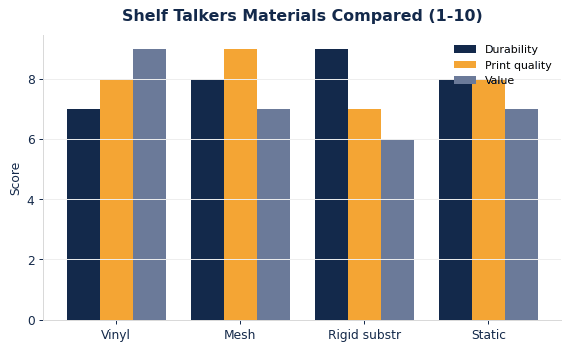
    The common materials for custom shelf talkers each trade off durability, print quality, and cost: vinyl, mesh, rigid substrate, and static / adhesive cling. The right pick depends on how the shelf talkers will be used, the look you want, and your budget. The chart and table below compare the main options so you can match material to job.

    How common shelf talkers materials compare on durability, print quality, and value.
    How common shelf talkers materials compare on durability, print quality, and value.

    As a rule of thumb, choose a recyclable or natural material when eco positioning matters, a coated or laminated option when you want vivid full-color print, and a premium build when the shelf talkers is part of a gift or high-end presentation. When in doubt, request a sample so you can judge feel and print before committing to a full run.

    Material / option Best for
    Vinyl durable, weather-resistant, vivid color
    Mesh wind-permeable for outdoor and fence use
    Rigid substrate sturdy for freestanding displays
    Static / adhesive cling residue-free application on glass

    Sizing and specs

    Sizing is where many shelf talkers orders go wrong, so measure before you order. Custom shelf talkers typically range from a small counter display up to a full backdrop or fence-length run, and the right size depends on the product or use they serve. Too small and the fit is tight or the product is exposed; too large and you pay for material you do not need and lose a clean, intentional look.

    When a measurement falls between standard options, size to the product with a small margin rather than guessing. Confirming the size on a proof or sample before a large run prevents the costly mistake of a full order that does not fit, which is far more expensive to fix than a five-minute check up front.

    Branding and decoration

    Decoration is what turns a plain shelf talkers into a branded one. Large-format digital printing reproduces full-color graphics sharply, with laminate options for durability and finish. Match the method to your artwork and budget: simple logos reproduce cleanly and cheaply, while detailed, full-color designs shine with the right process on the right material. Keep the artwork vector where possible and confirm the print area for your chosen size.

    Restraint usually reads as premium. A clean logo, one or two brand colors, and quality material almost always look more considered than a busy, over-printed design. Approving a proof before the run protects both the look and the budget, especially on a large order of custom shelf talkers.

    Ordering and budget

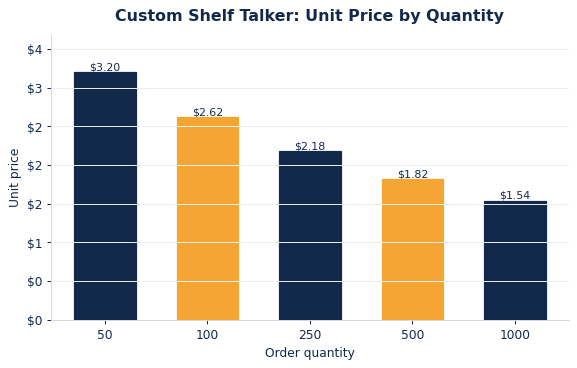
    Per-unit cost on custom shelf talkers falls steadily with volume as setup amortizes across more pieces, so ordering for real demand rather than a token first batch is usually the efficient move. The curve below shows how pricing typically improves with quantity, which helps you plan an order that balances cash and cost.

    Typical per-unit shelf talkers pricing as order quantity increases.
    Typical per-unit shelf talkers pricing as order quantity increases.
    Ordering for a recurring need? A single larger run lowers the unit cost and keeps your branding consistent, while a small overage covers reorders and the occasional damaged piece without a rush order.

    Common mistakes to avoid

    A few avoidable missteps account for most disappointing shelf talkers orders. Ordering before measuring is the biggest, followed by choosing a material for price alone without considering how the shelf talkers will actually be used, and skipping the proof on a large run. Each is easy to prevent with a few minutes of planning, and each is expensive to fix once a full order is produced.

    The other common trap is over-designing the artwork. Cramming in too many colors, effects, or details can muddy the print and raise the cost, especially on textured or recycled materials. Simplifying the design to a clean, legible mark almost always improves both the look and the price of your custom shelf talkers.

    Frequently asked questions about custom shelf talkers

    What material is best for custom shelf talkers?

    It depends on the use: choose a recyclable or natural material for eco positioning, a coated or laminated option for vivid full-color print, and a premium build for gifting or high-end presentation. Request a sample to judge feel and print before a full run of custom shelf talkers.

    How do I choose the right size?

    Measure the product or use the shelf talkers serves, then size to it with a small margin so the fit is clean without wasting material. When a measurement falls between standard options, size up slightly and confirm the size on a proof before ordering in volume.

    How are custom shelf talkers branded?

    Large-format digital printing reproduces full-color graphics sharply, with laminate options for durability and finish. Match the method to your artwork and budget, keep the art vector where possible, confirm the print area for your size, and approve a proof so the finished custom shelf talkers match your intent.

    How does pricing work, and is there a minimum?

    Per-unit cost drops with quantity as setup amortizes across the run, so larger orders are more cost-effective. Order for real demand plus a small overage rather than a token batch, and consolidate recurring needs into one run for the best price.

    Can I get a sample or proof before ordering?

    Yes, and it is strongly recommended. A physical sample lets you judge material and print, and a digital or physical proof confirms your artwork, color, and size before a full run — a small step that prevents a costly mistake on a large order.

    What do you need to quote custom shelf talkers?

    To quote accurately we need the size or the product they serve, the quantity, your material preference, and your artwork or a description of the branding. With those details we can recommend the right material and size and give you pricing for the run, and a proof follows once the order is confirmed.

    Whatever you order, send vector artwork, confirm material and size, and approve a proof before production. For help matching custom shelf talkers to a specific use, see our companion guide, our How to Choose Custom Shelf Talkers for Your Brand, and explore our our shop to start your order.

    Ready to order custom shelf talkers?

    Tell us your product, quantity, and branding and we’ll match the material, size, and decoration for you.

    Get a Quote

  • A Retailer’s Guide to Shelf Talker Margins and Economics — Custom Shelf Talkers

    Call or Text us: (929) 605-4397

    Home › Blog › A Retailer's Guide to Shelf Talker Margins and Economics

    Retail

    A Retailer’s Guide to Shelf Talker Margins and Economics

    06/30/2026

    Most retailers price a shelf talker program as a straight signage cost against doing nothing, see the line item, and hesitate. That comparison misses the actual return: a talker programmatically improves the odds a shopper picks your promoted SKU over the one next to it, at the exact moment they’re deciding.

    Here is a simple way to think about the margin math before your next program.

    The real per-unit cost

    A custom, full-color printed shelf talker at bulk volume typically adds a small fraction of a cent per unit to a promotion’s cost when spread across the units it’s meant to move. At a 5,000-unit order, that cost per shelf edge is often smaller than the margin on a single unit of the promoted product.

    Where the return shows up

    A well-placed talker increases the odds a comparing shopper chooses the called-out product, which shows up as incremental units sold during the promo window — not as a separate line item, but as lift on the products the talker is calling out.

    Order sizeTypical per-unit range*
    500$0.32–$0.45
    2,000$0.22–$0.32
    5,000$0.18–$0.26
    10,000+$0.15–$0.20

    *Estimates only, illustrative of typical volume pricing — request a quote for your exact specs.

    Budgeting for a program, not a single order

    A simple rule of thumb: treat shelf talkers as a cost of running the promotion, not as a separate signage expense to be justified on its own. Over a full promo calendar, the incremental cost of talkers is almost always smaller than the sales lift they generate on the SKUs they highlight.

    Key takeawayA custom shelf talker typically adds only a few cents per unit at volume, and the sales lift on the called-out product usually outweighs that cost many times over.

    Ready to build your program? Get a custom quote — free mockups in 24 hours. Learn more about how we work, or browse more guides.

    More posts

  • How to Order Custom Shelf Talkers: A Step-by-Step Checklist — Custom Shelf Talkers

    Call or Text us: (929) 605-4397

    Home › Blog › How to Order Custom Shelf Talkers: A Step-by-Step Checklist

    Ordering

    How to Order Custom Shelf Talkers: A Step-by-Step Checklist

    06/03/2026

    Most delays in a shelf talker order come from decisions that get made too late — a shape picked after the die is already cut, a mount style chosen after the quantity is locked. Working through these decisions in order, before you request a quote, gets you from idea to installed signage in the shortest possible time.

    Here’s the checklist we walk every new account through.

    1. Confirm your shelf sets and store count

    Count the number of shelf edges, end caps, or display locations you need to cover, and note whether it’s a one-time launch or a recurring program. This number drives your order quantity and price tier more than anything else.

    2. Pick your format

    Standard Rectangle for everyday price/promo, Clip-On for reusable durability, Die-Cut Shape for a launch moment, Fluorescent for a short-window sale, or Case-Stack Header for a full display anchor. If you’re unsure, tell us your use case and we’ll recommend one.

    3. Choose material and mount

    Card stock for shorter promo cycles, Coroplast for anything meant to survive multiple resets. Adhesive back for a permanent placement, clip or slotted mount for anything that needs to come off cleanly.

    StepWhat to have ready
    1. Shelf sets / store countNumber of locations, one-time vs. recurring
    2. FormatStandard, clip-on, die-cut, fluorescent, or header
    3. Material & mountCard stock or Coroplast; adhesive or clip
    4. ArtworkLogo file, brand colors, or a reference image
    5. DeadlineIn-hands date for your reset or launch

    4. Send your artwork

    Vector files (AI, EPS, SVG, PDF) are ideal. No logo yet? Send a photo, PDF, or description and our designers will build print-ready artwork at no charge.

    5. Confirm your deadline

    Tell us your in-hands date up front. Standard production runs one to two weeks from approved mockup; rush is available for firm launch or promo deadlines.

    Key takeawayLock your shelf count, format, and material before you request a quote — it’s the single biggest lever for a fast, on-deadline order.

    Ready to start? Get a custom quote — free mockups in 24 hours. Learn more about how we work, or browse more guides.

    More posts

  • Fluorescent vs. Full-Color: A Shelf Talker Durability & Standout Comparison — Custom Shelf Talkers

    Call or Text us: (929) 605-4397

    Home › Blog › Fluorescent vs. Full-Color: A Shelf Talker Durability & Standout Comparison

    Buyer guides

    Fluorescent vs. Full-Color: A Shelf Talker Durability & Standout Comparison

    05/13/2026

    Two print styles cover most shelf talker orders: a standard full-color print on white stock, and a full-color print over a fluorescent base. They look similar side by side in a mockup file, but they perform very differently once they’re on a real shelf competing for a shopper’s attention.

    Here’s how the two actually compare.

    Visibility at a distance

    Fluorescent stock reflects far more visible light than standard white stock, which is why a fluorescent yellow talker reads from several feet further away under normal store lighting. Full-color print on white stock is more legible up close, where detailed graphics and smaller type hold up better.

    Brand fit

    Full-color print is the better fit for anything carrying a logo, product photography, or multi-color branding — the fluorescent base can compete with subtler brand colors and wash them out. Fluorescent works best for short, high-contrast messages: a price, a percentage off, or a single word like “SALE.”

    FactorFull-color on whiteFluorescent
    Visibility at distanceModerateHigh
    Best for detailed brandingYesLimited
    Best use caseEveryday price/promoClearance, flash sale, markdown
    Typical costStandardSlightly higher

    Choosing for your promo

    If the goal is everyday shelf presence with your brand front and center, full-color on white or custom die-cut stock is the right default. If the goal is a short-window promotion that needs to be seen across the aisle, fluorescent earns its place — just keep the message short.

    Key takeawayFull-color print wins for brand detail and everyday signage; fluorescent wins for short, high-urgency promotions that need to be seen from a distance.

    Planning a promo cycle? Get a custom quote — free mockups in 24 hours. Learn more about how we work, or browse more guides.

    More posts

  • Who Actually Orders Custom Shelf Talkers? A Buyer’s Guide — Custom Shelf Talkers

    Call or Text us: (929) 605-4397

    Home › Blog › Who Actually Orders Custom Shelf Talkers? A Buyer's Guide

    Buyer guides

    Who Actually Orders Custom Shelf Talkers? A Buyer’s Guide

    04/22/2026

    Shelf talkers show up in more retail categories than most people realize, and each buyer approaches the order a little differently — different formats, different volumes, different urgency. If you’re ordering for the first time, it helps to know which profile you fall into.

    Here’s a quick tour of who buys shelf talkers and how they typically spec their order.

    Grocery & retail chains

    The highest-volume buyer. A chain-wide price or promo program means thousands of shelf edges across dozens or hundreds of stores, almost always in the Standard Rectangle or Fluorescent Sale format, ordered in runs of 5,000 to well over 10,000.

    Liquor & wine shops

    Smaller store counts but a strong preference for reusable Clip-On talkers — ratings, vintages, and pricing change often enough that a durable, removable mount saves money over a full season.

    CPG & brand manufacturers

    Order on behalf of retail partners, shipping a consistent talker kit to distributors and field merchandising teams. Die-Cut Shape and Case-Stack Header formats are common here, tied to a specific SKU launch.

    Buyer typeTypical formatTypical order size
    Grocery / retail chainStandard rectangle, fluorescent5,000–25,000+
    Liquor / wine shopClip-on500–2,500
    CPG / brand manufacturerDie-cut, case-stack header1,000–10,000
    Trade show / launch teamCase-stack header, die-cut500–1,500
    Boutique / specialty retailerStandard rectangle, die-cut500–1,000

    Choosing your starting order

    If you don’t fit neatly into one of these profiles, start with your store count and reset frequency: high store count and infrequent resets favor Coroplast and clip-on mounts; frequent promo turnover favors lower-cost card stock you’re comfortable reprinting.

    Key takeawayYour buyer profile — chain retailer, specialty shop, or brand manufacturer — points to a default format and order size before you even open a quote form.

    Not sure where you fit? Get a custom quote — free mockups in 24 hours. Learn more about how we work, or browse more guides.

    More posts

  • Card Stock vs. Coroplast: Choosing the Right Shelf Talker Material — Custom Shelf Talkers

    Call or Text us: (929) 605-4397

    Home › Blog › Card Stock vs. Coroplast: Choosing the Right Shelf Talker Material

    Materials

    Card Stock vs. Coroplast: Choosing the Right Shelf Talker Material

    04/01/2026

    The single biggest decision on a shelf talker order isn’t the shape or the color — it’s the material. Coated card stock and corrugated plastic (Coroplast) look similar in a mockup, but they behave very differently once they’re living on a real shelf edge for weeks or months.

    Here’s how to think about the trade-off before you place a bulk order.

    What card stock is good at

    Coated card stock is lighter, less expensive per unit, and prints with slightly crisper detail at small sizes. It’s the right call for shorter promo cycles, single-use campaigns, or any program where the talker will be replaced on the next reset anyway.

    What Coroplast is good at

    Corrugated plastic resists bending, moisture, and the general wear of being brushed by carts, restocked around, and handled by store staff. It holds its shape through reset after reset instead of curling or tearing, which matters for any talker meant to stay in place for a full season or longer.

    FactorCard stockCoroplast
    Cost per unitLowerModerate
    Typical lifespan on shelfWeeks to one seasonMultiple seasons
    Best mount styleAdhesive or tag pocketClip-on or slotted insert
    Best use caseShort promo cyclesReusable, long-run programs

    Choosing for your order

    If you’re running a limited-time sale or a single promo push, card stock keeps costs down without sacrificing the visual impact you need for that window. If you’re building a standing shelf-talker program that survives reset after reset — especially for clip-on or case-stack formats — Coroplast pays for itself in reduced reprint costs within one or two cycles.

    Key takeawayCard stock wins on cost for short campaigns; Coroplast wins on total cost for anything meant to survive more than one reset.

    Not sure which fits your program? Get a custom quote — free mockups in 24 hours. Learn more about how we work, or browse more guides.

    More posts

  • Shelf Talkers and the Conversion-Lift Case for Retail Signage — Custom Shelf Talkers

    Call or Text us: (929) 605-4397

    Home › Blog › Shelf Talkers and the Conversion-Lift Case for Retail Signage

    Conversion

    Shelf Talkers and the Conversion-Lift Case for Retail Signage

    03/15/2026

    A shopper standing in front of a shelf makes most of their decision in a few seconds, comparing whatever is directly in front of them. A blank price tag gives that shopper nothing but a number. A printed shelf talker gives them a reason — a callout, a comparison, a promo — at the exact moment the decision gets made.

    That’s the entire case for shelf talkers as a category, and it’s worth walking through the mechanics before you commit a budget to a program.

    Where the lift actually comes from

    Shelf talkers work because they interrupt the default path a shopper’s eyes take down a shelf. A row of identical price tags reads as background noise; a talker with color, a shape, or a bold call-out reads as new information, which pulls the eye and buys your product an extra half-second of consideration it wouldn’t otherwise get.

    What moves the needle most

    Not every talker performs the same. Contrast against the surrounding shelf, message clarity (a single benefit or price point beats a paragraph), and placement at eye level or at the point of comparison all matter more than size or material. A small, well-placed talker consistently outperforms a large, generic one.

    Signage typeTypical shopper attention
    Blank price tag onlyLow — read only if actively comparing
    Standard printed talkerModerate — color and message draw a glance
    Fluorescent sale talkerHigh — built specifically to interrupt scanning
    Die-cut shape or header talkerHighest — breaks the shelf plane entirely

    Measuring it in your own store

    You don’t need a lab study to see this work. Run a talker on half your locations or half your shelf sets for a promo cycle, leave the rest blank or with a generic tag, and compare sell-through. Most retailers who run this test once keep talkers in the program permanently.

    Key takeawayA shelf talker’s job is to interrupt a shopper’s scan for half a second longer than a blank tag would — contrast, clarity, and placement matter more than size.

    Ready to test it on your shelves? Get a custom quote — free mockups in 24 hours. Learn more about how we work, or browse more guides.

    More posts