Category: Uncategorized

  • Shelf Talkers, Wobblers, Blades, and Strips: Which Shelf-Edge Sign to Use

    Shelf Talkers, Wobblers, Blades, and Strips: Which Shelf-Edge Sign to Use

    The shelf edge is not one sign format, it is a small family of them, and they are not interchangeable. A fold-over card that quietly states a price does a different job from a spring-armed sign that bounces, and both do a different job from a blade that sticks out into the aisle. Order the wrong one and the sign either disappears against the product or gets pulled by a store manager who does not allow it. This is a plain comparison of the four shelf-edge formats retailers actually use, what each is good at, and how to match the format to the shopper you are trying to reach.

    The fold-over shelf talker: the quiet workhorse

    A classic shelf talker is a printed card that folds over the lip of the shelf and hangs down beside the product. The most common size is 3 inches wide by 5 inches tall with a 1-inch fold tab at the top, which leaves a visible face of about 3 by 4 inches; a horizontal variant runs roughly 8 inches wide by 4 inches tall. It is usually printed on 80- to 100-pound cover-weight card stock, heavy enough to hold its shape without curling. Its defining trait is simplicity: the fold tab grips the shelf edge on its own, so there is no adhesive, tape, or clip to fuss with, and staff can swap it in seconds. That makes it the right tool when the message lives right at the item, a price, a promotion, a single benefit line, and needs to change often. What it will not do is grab a shopper who is not already looking at that spot on the shelf.

    The wobbler: motion to catch a wandering eye

    A wobbler solves the attention problem the talker does not. It mounts a printed sign on a thin, springy arm, typically offered in 4-, 6-, and 8-inch lengths, that adheres to the shelf or upright at one end while the sign end floats free. As shoppers and carts pass, air movement makes the sign bounce and sway, and that motion is what pulls a distracted eye toward a new item or an impulse buy. The trade-offs are physical. Wobblers rely on adhesive, so you have to think about residue and clean removal on the fixture, and a sign that is flapping in the aisle is more exposed to being knocked or bent than one tucked at the shelf edge. Use a wobbler when the goal is interruption rather than reference, a new flavor, a limited drop, a seasonal tie-in.
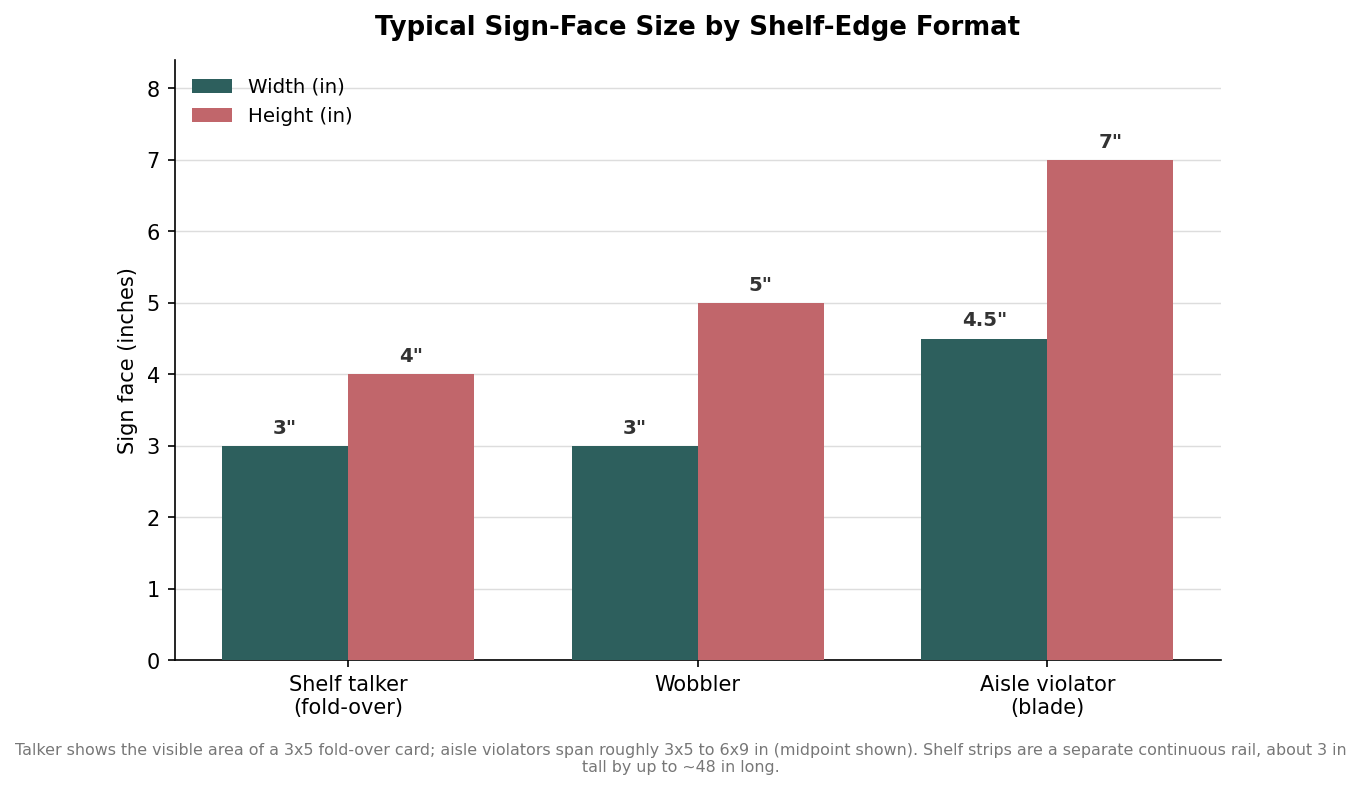
    Grouped bar chart of typical sign-face width and height for shelf talkers (3x4 in), wobblers (3x5 in), and aisle violator blades (about 4.5x7 in).
    Aisle violators carry the largest face because they must read from a distance; fold-over talkers are the most compact.

    The blade sign, or aisle violator: reaching down the aisle

    Where a talker and a wobbler both live at the shelf face, a blade sign, often called an aisle violator, projects perpendicular from the shelf so it breaks the visual plane of the aisle. That is the whole point: a shopper does not have to be standing in front of the product to see it, because the sign reaches into their line of sight from several feet away. Typical sizes run from about 3 by 5 inches up to 6 by 9 inches, and because these signs cantilever out into traffic they are frequently printed on rigid PVC or styrene rather than card, with heavier stock reserved for short promotions. Mounting options include adhesive foam tape, clip-on shelf channels, and magnetic strips. One caution belongs here more than anywhere: because they intrude into the aisle, blades are the format most likely to run into a retailer’s signage rules, so confirm they are permitted before you print a run.

    The shelf strip and rail: continuous edge messaging

    The fourth format is less of a single sign and more of a system. A shelf strip, or channel rail, is a long holder, commonly around 3 inches tall and up to roughly 48 inches long, with an adhesive back that runs along the front of the shelf. Instead of one message at one spot, it lets you insert a continuous band of price cards, product information, or category branding across the whole shelf, and the clear facing protects the printed inserts while still allowing barcodes to be scanned. A strip does not shout the way a wobbler or blade does. Its value is consistency and coverage, keeping an entire category on-brand and correctly priced, which is why it suits price rails and category headers rather than a single hero promotion.
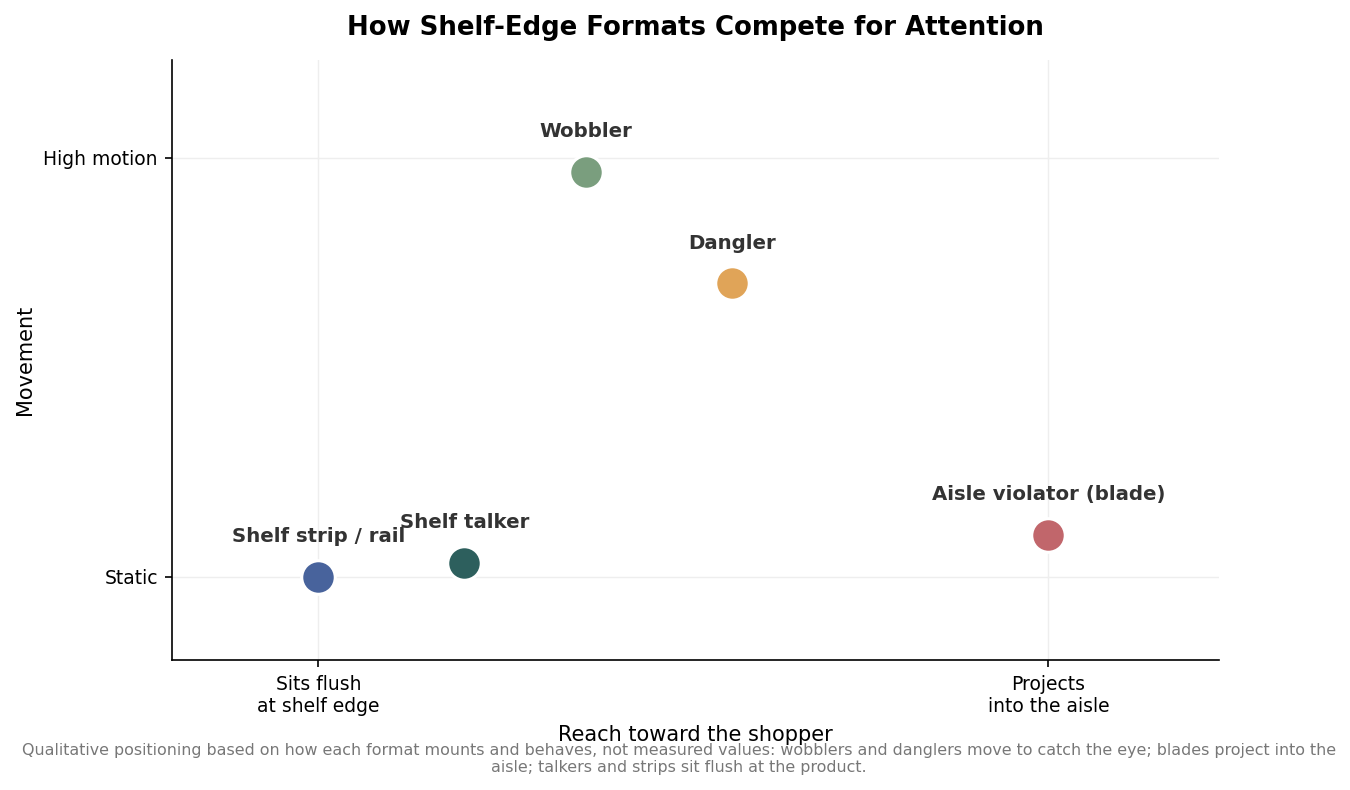
    Positioning map placing shelf strips and talkers as static and flush, wobblers and danglers as moving, and aisle violators as projecting into the aisle.
    A qualitative map of how each format competes for attention, by movement and by how far it reaches toward the shopper.

    Matching the format to the job

    The decision comes down to where the shopper’s eye already is and how long the sign has to survive. If the message is reference information that belongs next to a specific item and changes often, the fold-over talker is the cheapest, fastest choice. If you need to interrupt a passing shopper and pull them toward something new, the wobbler’s movement earns its keep. If the product sits mid-aisle and you need to announce it from a distance or off an endcap, the blade sign’s reach is what wins. And if you are branding or pricing a whole category rather than a single SKU, the continuous strip is the efficient answer.

    Two practical filters sit on top of that. The first is durability: match the stock to the dwell time, card for a two-week promotion, rigid PVC or styrene for a fixture that has to look clean for months. The second is permission. Many retailers publish point-of-purchase guidelines, and some restrict projecting aisle violators or adhesives on certain fixtures entirely, so the safest sequence is to get the store’s signage rules first and design the format to fit them, not the other way around. Choose the format for the shopper and the shelf it actually lives on, confirm it is allowed, and the sign does its job instead of ending up in a back-room bin.
  • Shelf Talker Mounting Types: How to Choose Size, Attachment, and Material

    Shelf Talker Mounting Types: How to Choose Size, Attachment, and Material

    A shelf talker only earns its keep if a shopper actually sees it and it survives the aisle long enough to matter. Both of those outcomes are decided less by the artwork than by two specifications people tend to pick last: the size and the way it attaches to the fixture. Get those wrong and even a beautiful design ends up crooked, hidden behind a facing, or on the floor by Tuesday. This is a side-by-side look at the sizes and mounting formats, and how to match them to where the sign will actually live.

    Start with size, because the shelf sets the limit

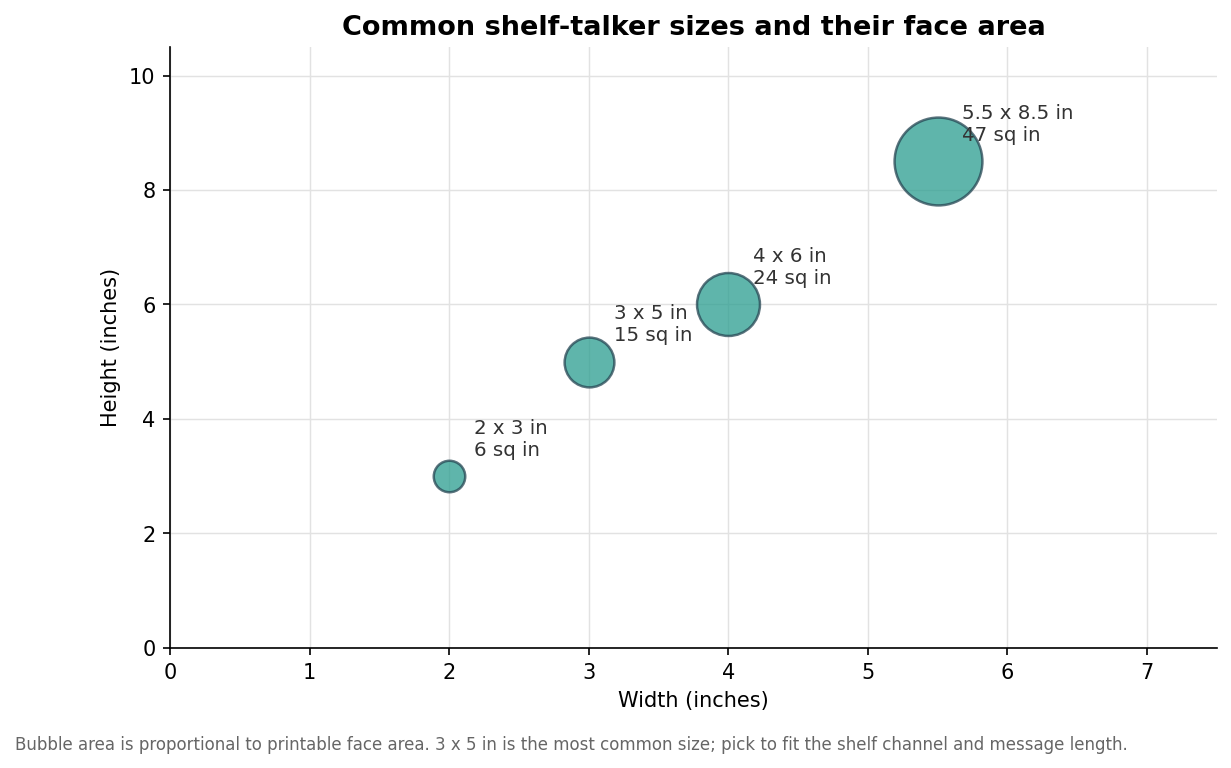
    Shelf talkers cluster around a handful of standard sizes, and the differences in printable area between them are larger than they look on a screen. The common ladder runs from a compact 2 by 3 inches up to a half-page 5.5 by 8.5, with 3 by 5 inches doing most of the work in real stores.

    Bubble scatter chart of common shelf talker sizes by width and height, from 2x3 inches to 5.5x8.5 inches, with face area
    Common shelf-talker sizes and their printable face area; 3 by 5 inches is the workhorse.

    The right size is a negotiation with the fixture, not a free choice. A grocery gondola with tight vertical spacing between shelves physically cannot accept a tall sign without it curling or colliding with the product above, which is why the compact sizes dominate food and beverage aisles. Wider, taller formats belong on endcaps, in cosmetics and electronics sections with more open facings, or anywhere the sign needs to carry a longer story rather than a single price or claim. A useful rule is to size for the message: a price point or a short callout wants a small talker, while a QR code, a few benefit lines, or regulatory text needs the larger face. When in doubt, measure the actual shelf channel before committing, because a sign that does not fit the fixture is scrap regardless of how good it looks.

    The five ways a shelf talker attaches

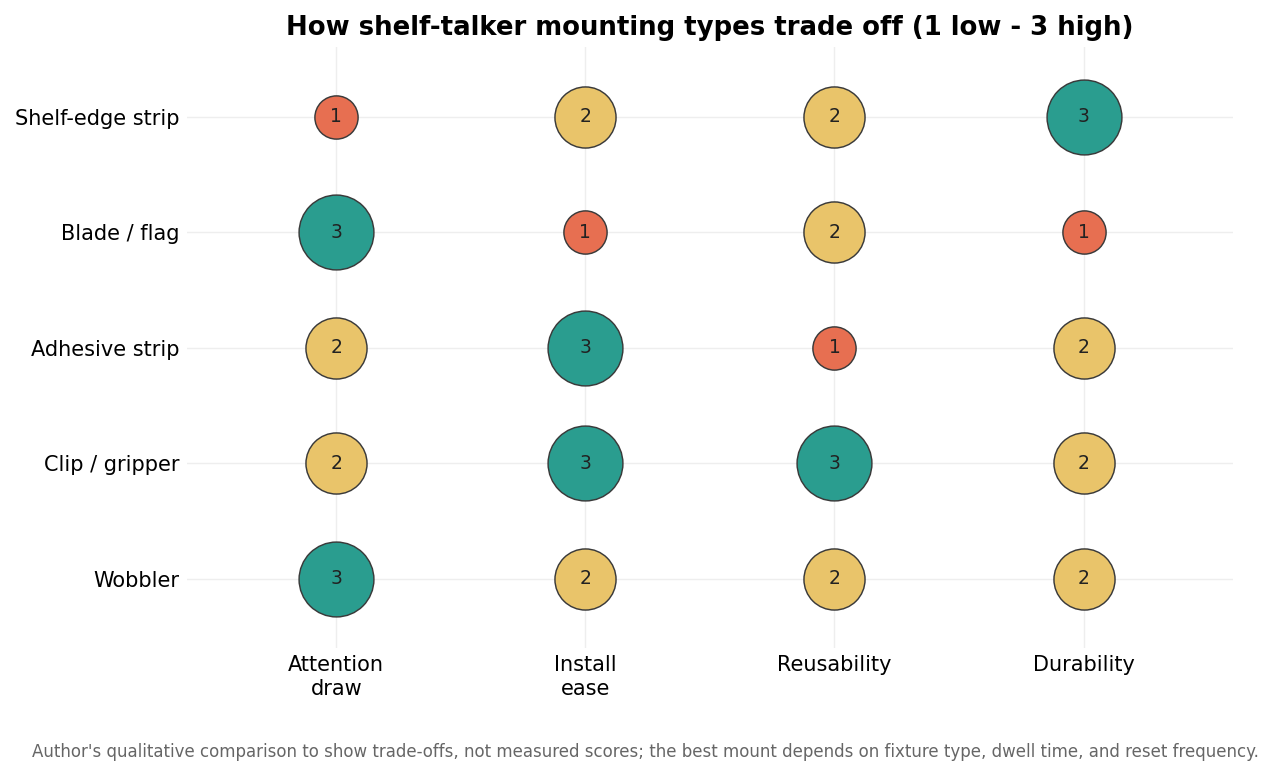
    Mounting is where shelf talkers genuinely diverge, and each format buys you something at the cost of something else. A wobbler hangs on a flexible arm so it bounces slightly with passing air and foot traffic, which draws the eye but can tangle or get bent. A clip or gripper snaps onto the shelf edge and is the most repositionable option, ideal for testing placements or frequent promo changes. An adhesive strip is the simplest to apply but is essentially single-use, since removing it cleanly is hit or miss. A blade or flag sign projects perpendicular into the aisle for maximum visibility down a long run, at the price of being easy to knock and prone to damage. A shelf-edge strip sits flush in the price channel, protected and tidy, but by design it does not stand out.

    Bubble matrix comparing shelf talker mounting types across attention, install ease, reusability, and durability
    Mounting formats trade attention against durability and reusability; the best choice depends on the placement.

    Reading the comparison, the pattern is that attention and durability rarely come in the same package. The formats that grab the most notice, the wobbler and the blade, are also the ones most exposed to being bent or bumped, while the tidy, protected shelf-edge strip is the least likely to be seen from a distance. There is no single best mount, only the one that fits how the sign is meant to work in a specific spot.

    Match the mount to the environment

    The environment usually makes the choice for you once you take it seriously. In a high-traffic promotional aisle where standing out matters and staff reset displays often, a clip-mounted talker gives you visibility plus the freedom to move it without residue or damage. In a slower, premium section where the sign will stay put for a season, an adhesive or channel mount keeps things clean and permanent. For a category where you are fighting for attention against a wall of similar products, a blade sign that breaks the plane of the shelf is worth the fragility, provided you accept a higher replacement rate. And in tightly regulated or tightly spaced aisles, the flush shelf-edge strip is often the only format that is even allowed.

    Two operational realities deserve weight here. First, reset frequency: if the campaign changes weekly, prioritize a mount you can remove and reposition without wrecking the sign or the fixture, which points to clips over adhesive. Second, the retailer’s own rules, because many chains restrict projecting signage and dictate approved holders; confirming that before you print saves an entire run from rejection at the door.

    Material follows the mount

    Once size and mount are set, the material almost chooses itself. Short-term promotions on a clip or adhesive mount are well served by coated cardstock, which prints vividly and costs the least, and a matte or gloss laminate adds enough scuff resistance to get through a few weeks of handling. Anything expected to live longer, face moisture, or ride an exposed blade should move to PVC or PET plastic, which shrug off humidity and bending that would dog-ear paper. Acrylic and rigid substrates exist for premium, semi-permanent displays where the sign is part of the fixture rather than a swappable promo. The through-line is simple: the more exposed and longer-lived the placement, the more durable and rigid the material needs to be, and paying for plastic on a one-week price flag is as wasteful as printing a season-long endcap sign on bare cardstock.

    Specifying the order

    A clean shelf-talker spec answers four questions in sequence: how big, how it mounts, what environment it lives in, and therefore what material and finish it needs. Decide the size against the real fixture, choose the mount for the balance of attention and durability the placement demands, confirm the retailer allows it, and let those choices dictate the substrate. Done in that order, the artwork lands where a shopper will see it and stays there long enough to do its job, which is the entire point of putting a sign on the shelf in the first place.

  • A Retailer’s Guide to Shelf Talker Margins and Economics — Custom Shelf Talkers

    Call or Text us: (929) 605-4397

    Home › Blog › A Retailer's Guide to Shelf Talker Margins and Economics

    Retail

    A Retailer’s Guide to Shelf Talker Margins and Economics

    06/30/2026

    Most retailers price a shelf talker program as a straight signage cost against doing nothing, see the line item, and hesitate. That comparison misses the actual return: a talker programmatically improves the odds a shopper picks your promoted SKU over the one next to it, at the exact moment they’re deciding.

    Here is a simple way to think about the margin math before your next program.

    The real per-unit cost

    A custom, full-color printed shelf talker at bulk volume typically adds a small fraction of a cent per unit to a promotion’s cost when spread across the units it’s meant to move. At a 5,000-unit order, that cost per shelf edge is often smaller than the margin on a single unit of the promoted product.

    Where the return shows up

    A well-placed talker increases the odds a comparing shopper chooses the called-out product, which shows up as incremental units sold during the promo window — not as a separate line item, but as lift on the products the talker is calling out.

    Order sizeTypical per-unit range*
    500$0.32–$0.45
    2,000$0.22–$0.32
    5,000$0.18–$0.26
    10,000+$0.15–$0.20

    *Estimates only, illustrative of typical volume pricing — request a quote for your exact specs.

    Budgeting for a program, not a single order

    A simple rule of thumb: treat shelf talkers as a cost of running the promotion, not as a separate signage expense to be justified on its own. Over a full promo calendar, the incremental cost of talkers is almost always smaller than the sales lift they generate on the SKUs they highlight.

    Key takeawayA custom shelf talker typically adds only a few cents per unit at volume, and the sales lift on the called-out product usually outweighs that cost many times over.

    Ready to build your program? Get a custom quote — free mockups in 24 hours. Learn more about how we work, or browse more guides.

    More posts

  • How to Order Custom Shelf Talkers: A Step-by-Step Checklist — Custom Shelf Talkers

    Call or Text us: (929) 605-4397

    Home › Blog › How to Order Custom Shelf Talkers: A Step-by-Step Checklist

    Ordering

    How to Order Custom Shelf Talkers: A Step-by-Step Checklist

    06/03/2026

    Most delays in a shelf talker order come from decisions that get made too late — a shape picked after the die is already cut, a mount style chosen after the quantity is locked. Working through these decisions in order, before you request a quote, gets you from idea to installed signage in the shortest possible time.

    Here’s the checklist we walk every new account through.

    1. Confirm your shelf sets and store count

    Count the number of shelf edges, end caps, or display locations you need to cover, and note whether it’s a one-time launch or a recurring program. This number drives your order quantity and price tier more than anything else.

    2. Pick your format

    Standard Rectangle for everyday price/promo, Clip-On for reusable durability, Die-Cut Shape for a launch moment, Fluorescent for a short-window sale, or Case-Stack Header for a full display anchor. If you’re unsure, tell us your use case and we’ll recommend one.

    3. Choose material and mount

    Card stock for shorter promo cycles, Coroplast for anything meant to survive multiple resets. Adhesive back for a permanent placement, clip or slotted mount for anything that needs to come off cleanly.

    StepWhat to have ready
    1. Shelf sets / store countNumber of locations, one-time vs. recurring
    2. FormatStandard, clip-on, die-cut, fluorescent, or header
    3. Material & mountCard stock or Coroplast; adhesive or clip
    4. ArtworkLogo file, brand colors, or a reference image
    5. DeadlineIn-hands date for your reset or launch

    4. Send your artwork

    Vector files (AI, EPS, SVG, PDF) are ideal. No logo yet? Send a photo, PDF, or description and our designers will build print-ready artwork at no charge.

    5. Confirm your deadline

    Tell us your in-hands date up front. Standard production runs one to two weeks from approved mockup; rush is available for firm launch or promo deadlines.

    Key takeawayLock your shelf count, format, and material before you request a quote — it’s the single biggest lever for a fast, on-deadline order.

    Ready to start? Get a custom quote — free mockups in 24 hours. Learn more about how we work, or browse more guides.

    More posts

  • Fluorescent vs. Full-Color: A Shelf Talker Durability & Standout Comparison — Custom Shelf Talkers

    Call or Text us: (929) 605-4397

    Home › Blog › Fluorescent vs. Full-Color: A Shelf Talker Durability & Standout Comparison

    Buyer guides

    Fluorescent vs. Full-Color: A Shelf Talker Durability & Standout Comparison

    05/13/2026

    Two print styles cover most shelf talker orders: a standard full-color print on white stock, and a full-color print over a fluorescent base. They look similar side by side in a mockup file, but they perform very differently once they’re on a real shelf competing for a shopper’s attention.

    Here’s how the two actually compare.

    Visibility at a distance

    Fluorescent stock reflects far more visible light than standard white stock, which is why a fluorescent yellow talker reads from several feet further away under normal store lighting. Full-color print on white stock is more legible up close, where detailed graphics and smaller type hold up better.

    Brand fit

    Full-color print is the better fit for anything carrying a logo, product photography, or multi-color branding — the fluorescent base can compete with subtler brand colors and wash them out. Fluorescent works best for short, high-contrast messages: a price, a percentage off, or a single word like “SALE.”

    FactorFull-color on whiteFluorescent
    Visibility at distanceModerateHigh
    Best for detailed brandingYesLimited
    Best use caseEveryday price/promoClearance, flash sale, markdown
    Typical costStandardSlightly higher

    Choosing for your promo

    If the goal is everyday shelf presence with your brand front and center, full-color on white or custom die-cut stock is the right default. If the goal is a short-window promotion that needs to be seen across the aisle, fluorescent earns its place — just keep the message short.

    Key takeawayFull-color print wins for brand detail and everyday signage; fluorescent wins for short, high-urgency promotions that need to be seen from a distance.

    Planning a promo cycle? Get a custom quote — free mockups in 24 hours. Learn more about how we work, or browse more guides.

    More posts

  • Who Actually Orders Custom Shelf Talkers? A Buyer’s Guide — Custom Shelf Talkers

    Call or Text us: (929) 605-4397

    Home › Blog › Who Actually Orders Custom Shelf Talkers? A Buyer's Guide

    Buyer guides

    Who Actually Orders Custom Shelf Talkers? A Buyer’s Guide

    04/22/2026

    Shelf talkers show up in more retail categories than most people realize, and each buyer approaches the order a little differently — different formats, different volumes, different urgency. If you’re ordering for the first time, it helps to know which profile you fall into.

    Here’s a quick tour of who buys shelf talkers and how they typically spec their order.

    Grocery & retail chains

    The highest-volume buyer. A chain-wide price or promo program means thousands of shelf edges across dozens or hundreds of stores, almost always in the Standard Rectangle or Fluorescent Sale format, ordered in runs of 5,000 to well over 10,000.

    Liquor & wine shops

    Smaller store counts but a strong preference for reusable Clip-On talkers — ratings, vintages, and pricing change often enough that a durable, removable mount saves money over a full season.

    CPG & brand manufacturers

    Order on behalf of retail partners, shipping a consistent talker kit to distributors and field merchandising teams. Die-Cut Shape and Case-Stack Header formats are common here, tied to a specific SKU launch.

    Buyer typeTypical formatTypical order size
    Grocery / retail chainStandard rectangle, fluorescent5,000–25,000+
    Liquor / wine shopClip-on500–2,500
    CPG / brand manufacturerDie-cut, case-stack header1,000–10,000
    Trade show / launch teamCase-stack header, die-cut500–1,500
    Boutique / specialty retailerStandard rectangle, die-cut500–1,000

    Choosing your starting order

    If you don’t fit neatly into one of these profiles, start with your store count and reset frequency: high store count and infrequent resets favor Coroplast and clip-on mounts; frequent promo turnover favors lower-cost card stock you’re comfortable reprinting.

    Key takeawayYour buyer profile — chain retailer, specialty shop, or brand manufacturer — points to a default format and order size before you even open a quote form.

    Not sure where you fit? Get a custom quote — free mockups in 24 hours. Learn more about how we work, or browse more guides.

    More posts

  • Card Stock vs. Coroplast: Choosing the Right Shelf Talker Material — Custom Shelf Talkers

    Call or Text us: (929) 605-4397

    Home › Blog › Card Stock vs. Coroplast: Choosing the Right Shelf Talker Material

    Materials

    Card Stock vs. Coroplast: Choosing the Right Shelf Talker Material

    04/01/2026

    The single biggest decision on a shelf talker order isn’t the shape or the color — it’s the material. Coated card stock and corrugated plastic (Coroplast) look similar in a mockup, but they behave very differently once they’re living on a real shelf edge for weeks or months.

    Here’s how to think about the trade-off before you place a bulk order.

    What card stock is good at

    Coated card stock is lighter, less expensive per unit, and prints with slightly crisper detail at small sizes. It’s the right call for shorter promo cycles, single-use campaigns, or any program where the talker will be replaced on the next reset anyway.

    What Coroplast is good at

    Corrugated plastic resists bending, moisture, and the general wear of being brushed by carts, restocked around, and handled by store staff. It holds its shape through reset after reset instead of curling or tearing, which matters for any talker meant to stay in place for a full season or longer.

    FactorCard stockCoroplast
    Cost per unitLowerModerate
    Typical lifespan on shelfWeeks to one seasonMultiple seasons
    Best mount styleAdhesive or tag pocketClip-on or slotted insert
    Best use caseShort promo cyclesReusable, long-run programs

    Choosing for your order

    If you’re running a limited-time sale or a single promo push, card stock keeps costs down without sacrificing the visual impact you need for that window. If you’re building a standing shelf-talker program that survives reset after reset — especially for clip-on or case-stack formats — Coroplast pays for itself in reduced reprint costs within one or two cycles.

    Key takeawayCard stock wins on cost for short campaigns; Coroplast wins on total cost for anything meant to survive more than one reset.

    Not sure which fits your program? Get a custom quote — free mockups in 24 hours. Learn more about how we work, or browse more guides.

    More posts

  • Shelf Talkers and the Conversion-Lift Case for Retail Signage — Custom Shelf Talkers

    Call or Text us: (929) 605-4397

    Home › Blog › Shelf Talkers and the Conversion-Lift Case for Retail Signage

    Conversion

    Shelf Talkers and the Conversion-Lift Case for Retail Signage

    03/15/2026

    A shopper standing in front of a shelf makes most of their decision in a few seconds, comparing whatever is directly in front of them. A blank price tag gives that shopper nothing but a number. A printed shelf talker gives them a reason — a callout, a comparison, a promo — at the exact moment the decision gets made.

    That’s the entire case for shelf talkers as a category, and it’s worth walking through the mechanics before you commit a budget to a program.

    Where the lift actually comes from

    Shelf talkers work because they interrupt the default path a shopper’s eyes take down a shelf. A row of identical price tags reads as background noise; a talker with color, a shape, or a bold call-out reads as new information, which pulls the eye and buys your product an extra half-second of consideration it wouldn’t otherwise get.

    What moves the needle most

    Not every talker performs the same. Contrast against the surrounding shelf, message clarity (a single benefit or price point beats a paragraph), and placement at eye level or at the point of comparison all matter more than size or material. A small, well-placed talker consistently outperforms a large, generic one.

    Signage typeTypical shopper attention
    Blank price tag onlyLow — read only if actively comparing
    Standard printed talkerModerate — color and message draw a glance
    Fluorescent sale talkerHigh — built specifically to interrupt scanning
    Die-cut shape or header talkerHighest — breaks the shelf plane entirely

    Measuring it in your own store

    You don’t need a lab study to see this work. Run a talker on half your locations or half your shelf sets for a promo cycle, leave the rest blank or with a generic tag, and compare sell-through. Most retailers who run this test once keep talkers in the program permanently.

    Key takeawayA shelf talker’s job is to interrupt a shopper’s scan for half a second longer than a blank tag would — contrast, clarity, and placement matter more than size.

    Ready to test it on your shelves? Get a custom quote — free mockups in 24 hours. Learn more about how we work, or browse more guides.

    More posts