The shelf edge is not one sign format, it is a small family of them, and they are not interchangeable. A fold-over card that quietly states a price does a different job from a spring-armed sign that bounces, and both do a different job from a blade that sticks out into the aisle. Order the wrong one and the sign either disappears against the product or gets pulled by a store manager who does not allow it. This is a plain comparison of the four shelf-edge formats retailers actually use, what each is good at, and how to match the format to the shopper you are trying to reach.
The fold-over shelf talker: the quiet workhorse
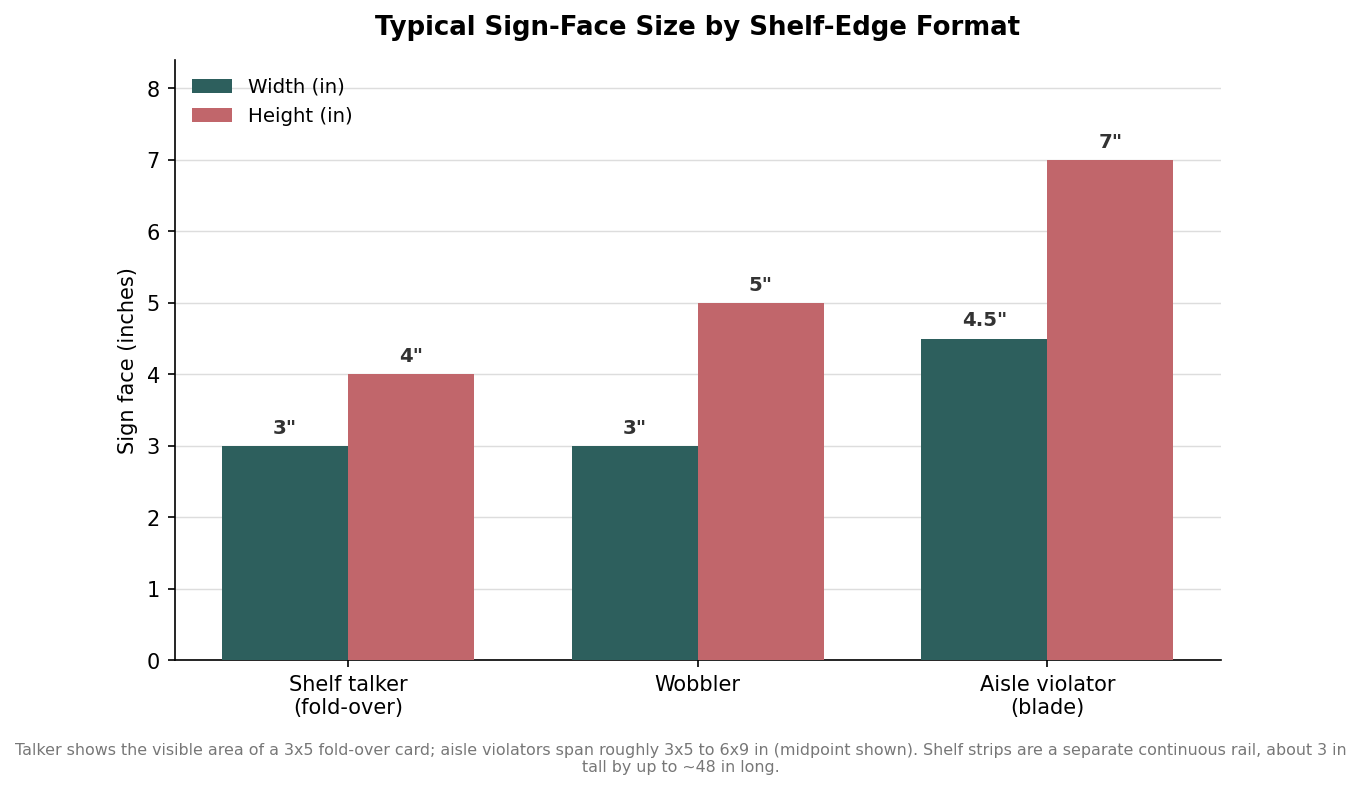
A classic shelf talker is a printed card that folds over the lip of the shelf and hangs down beside the product. The most common size is 3 inches wide by 5 inches tall with a 1-inch fold tab at the top, which leaves a visible face of about 3 by 4 inches; a horizontal variant runs roughly 8 inches wide by 4 inches tall. It is usually printed on 80- to 100-pound cover-weight card stock, heavy enough to hold its shape without curling. Its defining trait is simplicity: the fold tab grips the shelf edge on its own, so there is no adhesive, tape, or clip to fuss with, and staff can swap it in seconds. That makes it the right tool when the message lives right at the item, a price, a promotion, a single benefit line, and needs to change often. What it will not do is grab a shopper who is not already looking at that spot on the shelf.
The wobbler: motion to catch a wandering eye
A wobbler solves the attention problem the talker does not. It mounts a printed sign on a thin, springy arm, typically offered in 4-, 6-, and 8-inch lengths, that adheres to the shelf or upright at one end while the sign end floats free. As shoppers and carts pass, air movement makes the sign bounce and sway, and that motion is what pulls a distracted eye toward a new item or an impulse buy. The trade-offs are physical. Wobblers rely on adhesive, so you have to think about residue and clean removal on the fixture, and a sign that is flapping in the aisle is more exposed to being knocked or bent than one tucked at the shelf edge. Use a wobbler when the goal is interruption rather than reference, a new flavor, a limited drop, a seasonal tie-in.
The blade sign, or aisle violator: reaching down the aisle
Where a talker and a wobbler both live at the shelf face, a blade sign, often called an aisle violator, projects perpendicular from the shelf so it breaks the visual plane of the aisle. That is the whole point: a shopper does not have to be standing in front of the product to see it, because the sign reaches into their line of sight from several feet away. Typical sizes run from about 3 by 5 inches up to 6 by 9 inches, and because these signs cantilever out into traffic they are frequently printed on rigid PVC or styrene rather than card, with heavier stock reserved for short promotions. Mounting options include adhesive foam tape, clip-on shelf channels, and magnetic strips. One caution belongs here more than anywhere: because they intrude into the aisle, blades are the format most likely to run into a retailer’s signage rules, so confirm they are permitted before you print a run.
The shelf strip and rail: continuous edge messaging
The fourth format is less of a single sign and more of a system. A shelf strip, or channel rail, is a long holder, commonly around 3 inches tall and up to roughly 48 inches long, with an adhesive back that runs along the front of the shelf. Instead of one message at one spot, it lets you insert a continuous band of price cards, product information, or category branding across the whole shelf, and the clear facing protects the printed inserts while still allowing barcodes to be scanned. A strip does not shout the way a wobbler or blade does. Its value is consistency and coverage, keeping an entire category on-brand and correctly priced, which is why it suits price rails and category headers rather than a single hero promotion.
Matching the format to the job
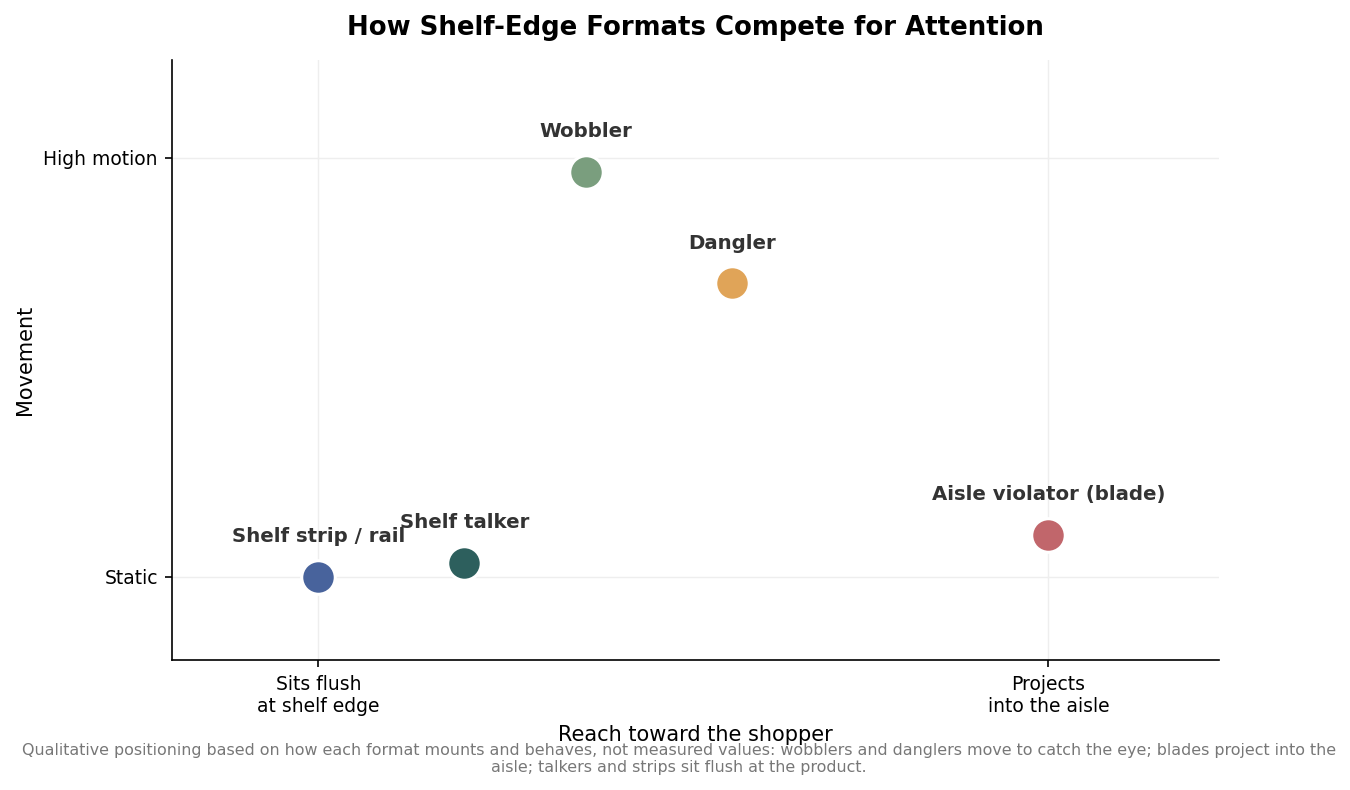
The decision comes down to where the shopper’s eye already is and how long the sign has to survive. If the message is reference information that belongs next to a specific item and changes often, the fold-over talker is the cheapest, fastest choice. If you need to interrupt a passing shopper and pull them toward something new, the wobbler’s movement earns its keep. If the product sits mid-aisle and you need to announce it from a distance or off an endcap, the blade sign’s reach is what wins. And if you are branding or pricing a whole category rather than a single SKU, the continuous strip is the efficient answer.
Two practical filters sit on top of that. The first is durability: match the stock to the dwell time, card for a two-week promotion, rigid PVC or styrene for a fixture that has to look clean for months. The second is permission. Many retailers publish point-of-purchase guidelines, and some restrict projecting aisle violators or adhesives on certain fixtures entirely, so the safest sequence is to get the store’s signage rules first and design the format to fit them, not the other way around. Choose the format for the shopper and the shelf it actually lives on, confirm it is allowed, and the sign does its job instead of ending up in a back-room bin.
Leave a Reply